On finding my way back to reading for fun
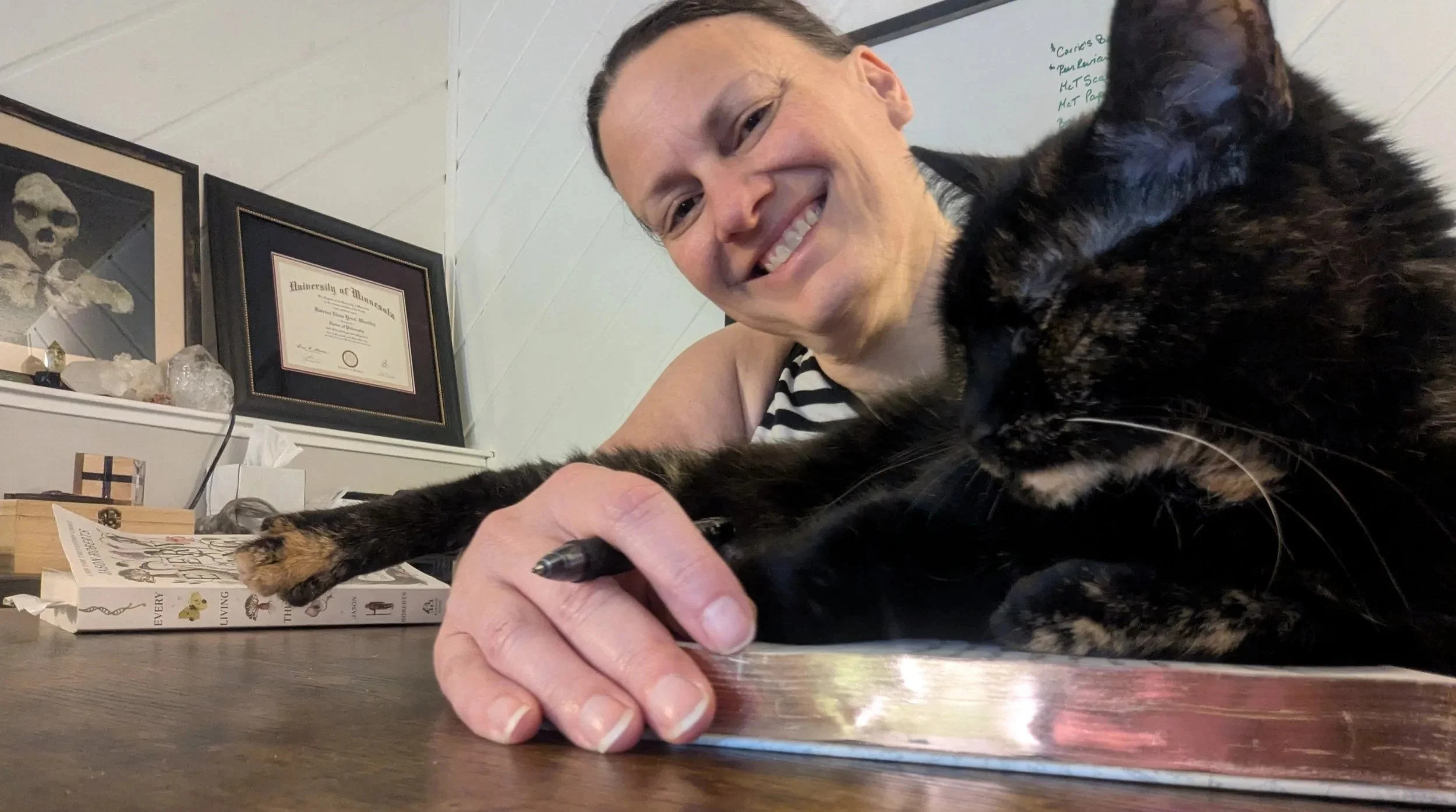
Nova, the kitty, offering her editorial assistance by sitting directly on my journal.
Dear Friend,
Thank you for taking time to read this—the first of what I hope will be many entries in my new reading journal.
When I was a little girl, I hid a flashlight under my pillow so I could continue reading into the night after Mom turned the lights out and told me it was time to go to sleep. In my twenties, I continued to read, and I would walk around with a book and a journal in my bag. In between appointments and other obligations, I would carve out moments to sit by a lake, often Bde Maka Ska, to read or pen my deepest thoughts. This was a time in life when I engaged regularly in reading for pleasure and writing creatively.
This was well before I tackled my first peer-reviewed manuscript and honed my skills reading and writing in the formulaic pattern of academic research literature in my field: abstract, intro, materials, methods, results, discussion, and conclusion. This was well before I had to consume exorbitant amounts of dry, academic literature filled with mind-numbing and dense statistical methods and data-rich results that are often a necessary pathway to arrive at the more interesting inferences that captured my attention. Of course, these readings were rife with new vocabularies that excited me in the moment yet proved difficult to retain.
I would spend days on the same article while my peers would talk about consuming entire books or several articles in a single day. I tried to apply well-known strategies: read the abstract, the first and last sentences of the first and last paragraph, and the first sentence of every subsequent paragraph. It was somewhat helpful, but not game-changing. As I trudged through the readings, I felt as though I was swimming across lakes filled with copious amounts of seaweed wrapping around my arms and legs with every stroke as I tried to pull myself through the waters. I felt as though I was drowning.
I eventually found myself despairing in the office of one of the members of my committee, feeling discouraged and fearful about my prospects because I struggled to focus and seemed exponentially slower than my academic peers when it came to consuming the literature necessary for my education. Furthermore, I struggled to recall anything without great effort. He expressed understanding and tried to encourage me by letting me know that I was not alone and that many of us feel that way. It is normal. He advised me to read voraciously. Read. Keep reading. Read all the time. It will get better.
He was right insofar as it did get better, though I don’t think he understood the depth of the problem and I, thinking that something was fundamentally wrong with me, was too ashamed to provide any concrete data about just how long it was taking me to get through individual articles.
It wouldn’t be until two weeks after I earned my PhD that I would undergo a litany of cognitive tests that culminated in an ADHD diagnosis. I had white-knuckled my way through my education and parenting my children through theirs—neither task being particularly natural for the ADHD brain. Those tests revealed that I ranked incredibly high in information processing speed, yet middle-of-the-road in working memory, which is the precursor to encoding information in long-term memory. It seems rather pointless to process information at high speeds just to throw it all away.
No wonder I couldn’t stay focused while reading peer-reviewed research papers. No wonder I struggled with instant recall in academic conversations during which I felt additional pressure to prove intellectual belonging, which I myself doubted—a pressure that was exacerbated by the anxiety I developed over years of feeling simultaneously intelligent yet stupid, and consistently inadequate, as though something was fundamentally wrong with me.
Transferring working memory to long-term memory—or even maintaining concentration—has, for me, required tremendous external scaffolding. Copious note-taking and memory-aid devices became necessary for staying focused, much less remembering anything. Truth be told, if I am not actively using information, it disappears into the deepest recesses of my mind and the concept of “it’s just a matter of getting back on the horse again” is of minimal comfort to me. I have come to understand that anything beginning with the word “just” is really not that applicable to my life.
Needless to say, you can imagine the degree of effort I put in to compensate for the cognitive difference I didn’t yet know I had. Of course, reading and writing for pleasure and the sheer enjoyment of entertaining ideas without dissecting them fell by the wayside early on in my tenure as a graduate student.
It’s been a few years, and I’ve struggled to find my way back to reading for fun. I’ve often thought that it might be fun to blog about what I am reading but haven’t started out of fear. I feel the pressure to perform my academic identity as though I am expected to know, or fully research and vet, every idea I wish to express in order to maintain credibility and a modicum of belonging in intellectual spheres. This is debilitating and paralyzing. With this mindset, one can easily develop the fear of being perceived—a fear I now have.
Since graduating, I have approached reading for pleasure like I tackle a research project, taking copious notes, trying to remember as much as I can, critically evaluating ideas and taking notes on what requires further examination and research. This does not entice me to return the next day and, in fact, transforms what is supposed to be a pleasurable respite into yet another over-scoped obligation.
I am abandoning this approach.
Instead, I am giving myself permission to be perceived in the process of trying to return to reading (and writing) for fun. I will indulge myself with what moves me in the moment. Perhaps I will share with you an idea that intrigued me, or perhaps I won’t share anything about what I read, but rather what I experienced in my effort to return to the reader in me. I may read slowly. I may not. I may vet an idea. I may simply enjoy contemplating it using only my current knowledge. I may forget it shortly after reading it. Who knows? Regardless, I am going to blog when the desire strikes and perhaps, in addition to doing something for the pure enjoyment of it, I will find community. If you relate to anything that I’ve written here or it has inspired an idea, I’d love to hear about your experience too.
As part of this endeavor, I joined Bookshop.org’s affiliate program and have been putting together reading lists—what I am currently reading and what I hope to read in the future—all centered on themes that appeal to me. I invite you to check out my lists. Some of the links on this site are affiliate links. If you make a purchase through one of them, I may earn a small commission at no additional cost to you. If you do decide to purchase through one of my affiliate links I do appreciate it. Please don’t feel any pressure to purchase anything; I’m equally happy simply to share books and connect over what we’re reading.
With warmest regards,
Katrina
Originally drafted: 25 July 2026 at 11:00 (Minnesota)
© 2026 Katrina Yezzi-Woodley. All Rights Reserved.